
What's the difference between pathway lighting and accent lighting?
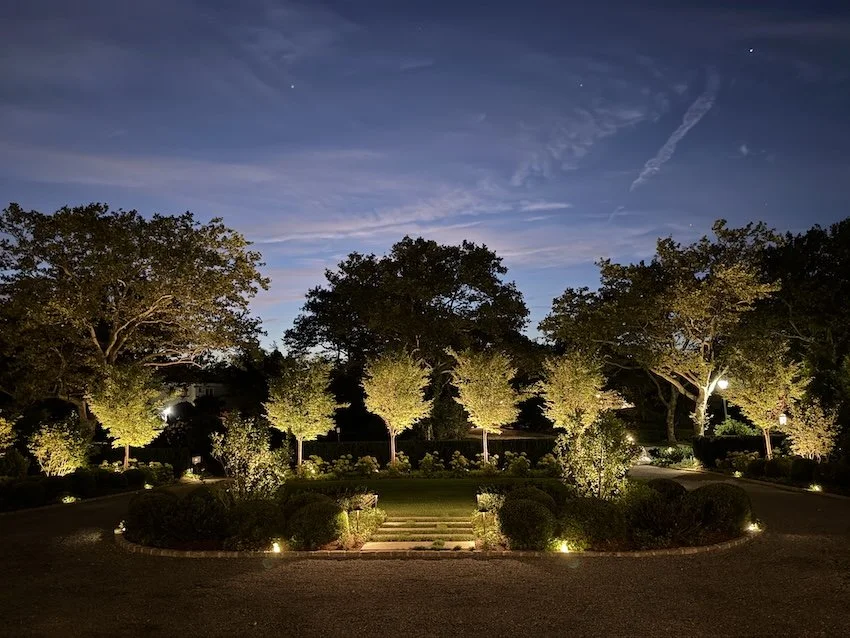
Location: Hewlett, NY.
One of the most common mistakes in landscape lighting is thinking that adding enough pathway lights will illuminate the entire property. It won't. A driveway can be perfectly visible while the trees beside it disappear into darkness. The opposite can happen, too: a beautifully illuminated garden can still have a walkway that's difficult to navigate.
Pathway lighting and accent lighting solve different problems, and understanding that distinction changes how an outdoor lighting project should be planned. The question isn't just which fixtures to install. It's where light is needed for visibility, which features deserve attention, and how the two can work together without making the property look overlit.
What is pathway lighting?
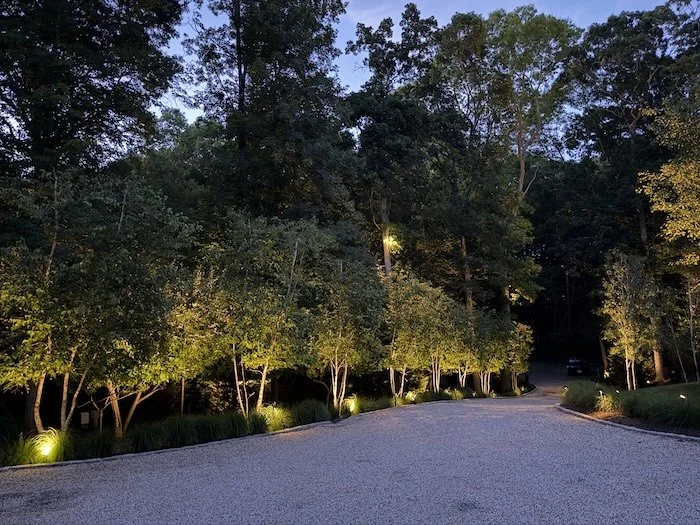
Location: Sag Harbor, NY.
Pathway lighting illuminates outdoor walking areas, including front walkways, garden paths, driveway edges, and routes connecting different areas of a property. Its primary purpose is to help people navigate safely by making the walking surface, changes in elevation, and direction of travel easier to see.
Pathway lights are commonly installed along the edges of walkways or driveways, with their light directed toward the ground. However, effective pathway lighting requires more than placing fixtures at regular intervals. Their height, spacing, light distribution, and relationship to the surrounding landscape all influence the result.
Too many pathway lights can make a property look like an airport runway. Fixtures placed too close together create a repetitive pattern that competes with the home's architecture and surrounding landscaping. The objective is to provide enough illumination to guide people comfortably without making the fixtures themselves the main attraction.
Types of pathway lighting fixtures
Pathway lighting fixtures come in a wide range of shapes, heights, and designs. The right choice depends on the home's architecture, the walkway's layout, and whether visible fixtures or a more discreet appearance is preferred.
Hat-style and mushroom path lights: These have shaded or rounded tops that direct light toward the ground. They work well along residential walkways, garden paths, and driveway edges.
Pagoda and lantern-style lights: Decorative fixtures that can complement traditional architecture, formal entrances, and established gardens.
L-shaped and modern linear lights: Streamlined designs suited to contemporary homes, with defined profiles and directional light.
Bollard lights: Taller, post-like fixtures that can work along wider walkways and driveway approaches. Their height and light distribution need careful consideration to avoid glare.
Low-profile and shielded path lights: Compact fixtures designed to minimize their visual presence while directing light toward the walking surface.
In-ground well lights: Installed flush with the ground, these can mark a pathway without introducing visible fixtures above the surface.
Step and hardscape lights: Integrated into stairs, retaining walls, or masonry, these help illuminate changes in elevation and transitions along outdoor routes.
These categories can overlap, and some fixtures serve more than one purpose. Choosing the right option requires considering both appearance and function. Traditional hat-style lights may suit one property, while in-ground fixtures or modern bollards may be more appropriate for another.
What is accent lighting?
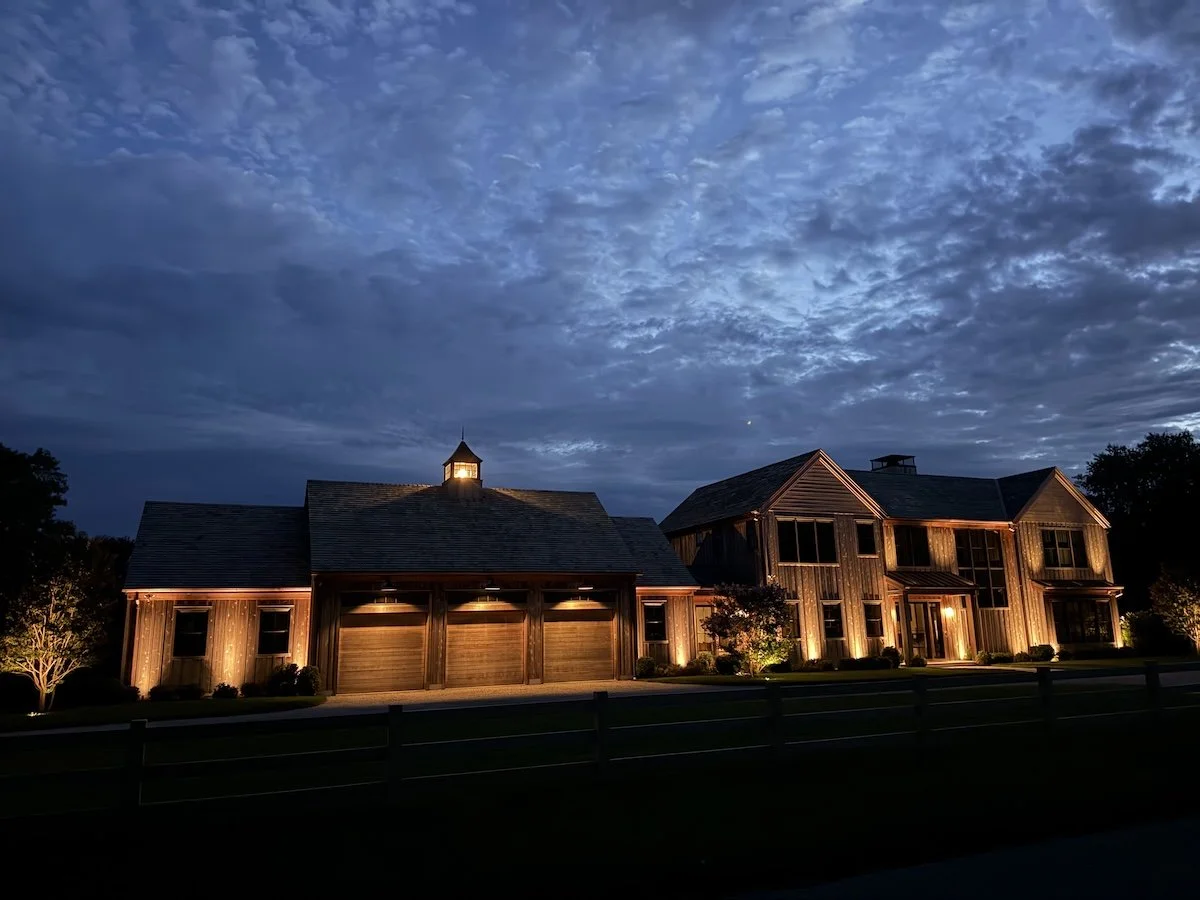
Location: Remsenburg, NY.
Accent lighting highlights selected features of a property's architecture and landscape. Rather than primarily illuminating a walking surface, it directs attention toward elements that contribute to the property's character.
Common applications include:
Mature trees and distinctive tree canopies
Architectural columns, stone facades, and exterior textures
Sculptures and garden art
Specimen plants and selected garden beds
Retaining walls and other landscape structures
Features around patios and poolside areas
Accent lighting commonly uses directional fixtures, such as spotlights and well lights, to illuminate a specific subject. The fixture's beam angle, brightness, and placement depend on the feature being illuminated and the intended effect.
For example, a narrow beam may emphasize the trunk and branching structure of a tree, while a wider beam may be more suitable for its canopy. A spotlight aimed at a stone facade can bring out its texture, while a fixture placed at an unsuitable angle may create unwanted glare or harsh shadows.
Why not every plant needs accent lighting
A garden may contain dozens of trees, shrubs, and ornamental plants, but illuminating every one can make the landscape look crowded. When everything receives equal attention, nothing stands out.
A more considered design establishes a visual hierarchy. A mature tree might serve as the primary focal point, with a sculpture or architectural feature providing a secondary point of interest. Other areas can remain darker, creating contrast and allowing the illuminated features to stand out.
The result depends as much on fixture placement and restraint as on the number of lights installed.
Pathway lighting vs. Accent lighting: What's the difference?
The main difference is their intended purpose. Pathway lighting helps people navigate outdoor spaces, while accent lighting emphasizes specific architectural and landscape features.
Pathway Lighting
Purpose: Guides movement and improves visibility.
Where it's used: Walkways, driveways, and garden paths.
Common fixtures: Hat-style, mushroom, L-shaped, bollard, and in-ground lights.
Placement focuses on: Path visibility, spacing, and glare control.
Design goal: Safe, comfortable navigation.
Accent Lighting
Purpose: Highlights architectural and landscape features.
Where it's used: Trees, sculptures, facades, and specimen plants.
Common fixtures: Spotlights and directional well lights.
Placement focuses on: Viewing angles, beam direction, and visual impact.
Design goal: Depth, contrast, and focal points.
Some fixtures can serve both purposes depending on their placement and beam direction. An in-ground well light, for example, can mark a pathway or illuminate a tree. The distinction comes down to how the fixture is positioned and what the light is intended to accomplish.
Can pathway lighting and accent lighting be used together?
Yes. Most thoughtfully designed residential landscape lighting systems benefit from a combination of both.
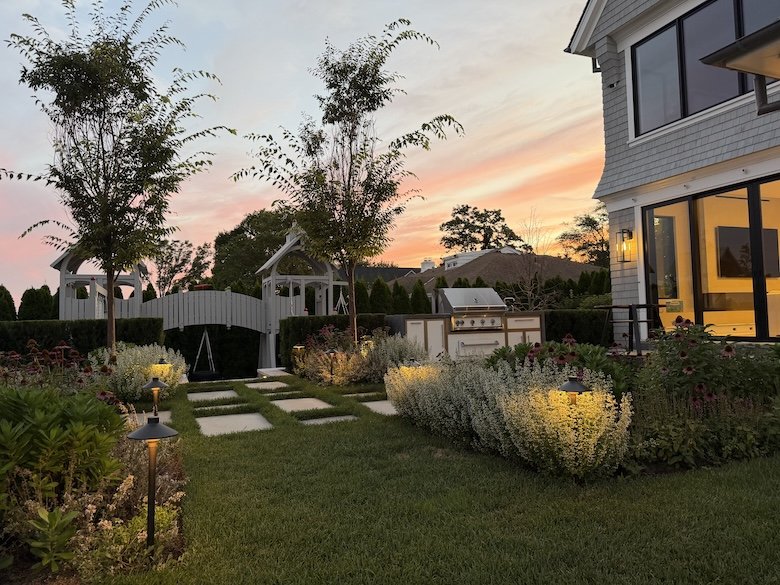
Location: Hewlett, NY.
Pathway lighting establishes the routes people use to move through the property. Accent lighting adds visual interest by highlighting the trees, architecture, and other features surrounding those routes. Together, they create layers of light that make the landscape functional and visually engaging.
Using pathway lights alone may provide sufficient visibility but leave the property's most interesting features in darkness. Relying exclusively on accent lighting can produce attractive focal points while leaving the routes between them difficult to navigate.
Neither type replaces the other. The right balance depends on the property's layout, the homeowner's priorities, and the features that deserve attention.
A real example: Pathway and accent lighting in Suffolk County (Sag Harbor, NY)
A residential landscape lighting project in Sag Harbor illustrates how these two approaches work together.
Location: Sag Harbor, NY.
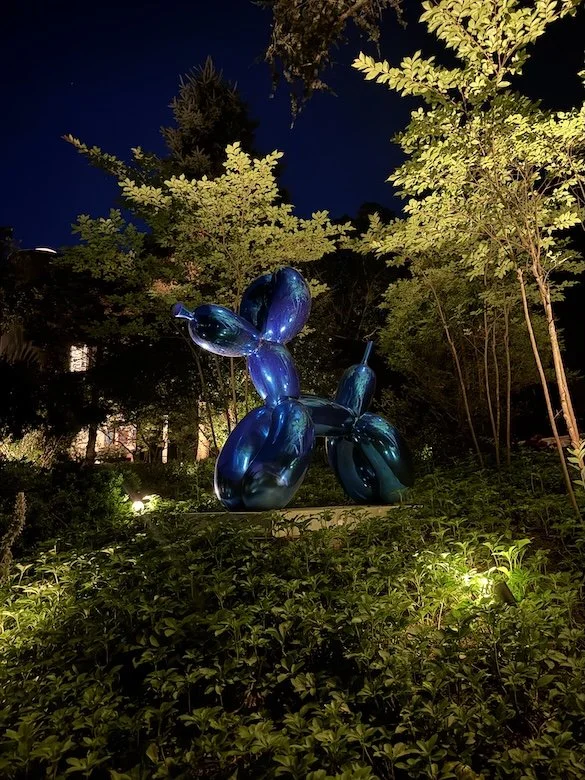
The property had a long driveway that the homeowners wanted illuminated. In the front yard, a Jeff Koons sculpture presented another design opportunity. The distinctive artwork deserved to be appreciated after dark rather than disappear into the surrounding landscape.
Pathway lights were installed along the driveway and path to provide visual guidance. Accent lighting was directed toward the sculpture and surrounding trees, giving the artwork greater prominence and adding depth to the front yard.
Each part of the design served a different purpose. The pathway lighting addressed movement and visibility, while accent lighting established the sculpture and trees as focal points. The driveway could be illuminated without becoming the property's main visual attraction, and the sculpture could stand out without leaving the surrounding routes unlit.
The same principle applies to properties throughout Nassau County and Suffolk County, whether the focal point is a mature oak in Old Westbury, a stone facade in Roslyn, or a distinctive garden feature in the Hamptons.
How to plan pathway and accent lighting
Several factors determine how these two types of lighting should be combined.
1. Match fixtures to the architecture
Pathway fixtures are visible design elements, so their appearance matters. Traditional hat-style fixtures, L-shaped designs, bollards, and in-ground well lights each create a different visual effect. The best choice depends on the home's architecture, surrounding landscape, and the specific location.
2. Consider different viewing angles
Accent lighting should be evaluated from multiple positions. A tree may look impressive from the driveway but appear completely different from a living room window.
The design should account for views from inside the house, from the curb, and while moving through the landscape. Seasonal changes also matter: trees lose their leaves, plants grow, and garden beds change throughout the year, affecting how light reaches a feature.
3. Choose the right brightness and color temperature
Brightness and color temperature can make or break an outdoor lighting project. Excessively bright fixtures can produce glare, wash out architectural details, and make a residential property feel harsh.
For many residential landscape lighting projects, warm white light between 2700K and 3000K creates a comfortable appearance that complements stone, brick, wood, and greenery. The appropriate color temperature can vary with the architecture and landscape, but consistency across the property is important.
4. Avoid overlighting
More fixtures do not automatically produce a better result. Too many pathway lights create a runway effect, while illuminating every tree and shrub can eliminate the contrast that gives a landscape depth.
A successful design identifies which areas require functional illumination, selects meaningful focal points, and leaves other areas relatively dark. This creates a more natural nighttime appearance without unnecessary fixtures.
5. Plan the entire system before installation
Landscape lighting involves technical considerations as well as aesthetics. Transformer capacity, electrical loading, cable runs, fixture placement, and the overall system layout all influence performance.
Installing a few fixtures independently and adding more later can lead to unnecessary expenses, inconsistent placement, or technical limitations that could have been addressed from the beginning. An overloaded transformer or poorly planned layout may require additional work to correct.
Online articles can explain the basics, but they cannot account for every property's specific conditions. Planning the complete system in advance helps align the visual design with its technical requirements and avoid unnecessary costs.
Landscape lighting design and installation on Long Island, NY
If you have any questions or need assistance with landscape lighting services for your property, we're here to help. We offer professional design and installation services on Long Island, NY (Nassau County and Suffolk County), and the surrounding areas. Contact us today and we’ll connect you with one of our expert lighting designers to discuss your needs and provide a custom design proposal for your home.