
Outdoor step lighting on Long Island: Safer stairs after dark
Outdoor stairs tend to disappear once the sun goes down. During the day, changes in elevation, the edge of a stone step, or the transition from one level of a property to another are easy to see. At night, the same staircase can become much harder to navigate.
That is where outdoor step lighting becomes important. Properly designed lighting makes stairs easier to see and safer to use, but it can also do something more subtle: make the staircase feel like a natural part of the property after dark.
For a Long Island home with patios, gardens, retaining walls, pools, terraces, or multiple levels of outdoor space, stairs are often part of a larger landscape. The lighting should reflect that. Rather than treating the staircase as an isolated area that needs a few lights, step lighting works best when it is considered as part of the property's overall landscape lighting design.
This is especially relevant across Nassau County and Suffolk County, where residential properties range from traditional homes with masonry steps and established gardens to newer homes with expansive terraces, pools, and multi-level outdoor living areas.
The difference is noticeable. A staircase can be brightly illuminated and still look awkward, or it can be softly and intentionally lit so that the steps, surrounding landscape, and architecture all work together.
Why outdoor step lighting on Long Island is about more than safety
Safety is usually the reason homeowners start thinking about outdoor stair lighting.
A poorly visible step can be enough to cause a trip, particularly when a staircase has uneven surfaces, several changes in elevation, or connects areas of the property that are used frequently in the evening. Good step lighting makes those transitions easier to see and gives people a clearer sense of where each step begins and ends.
But once safety is addressed, another question becomes important: What should the staircase look like at night?
Outdoor lighting is part of the visual experience of a home after sunset. A staircase that has been carefully designed during the day should not suddenly look like a separate, brightly illuminated structure at night.
The goal is to make the steps visible without making the lighting itself the focus.
That usually means using controlled illumination rather than simply adding more light. The staircase should feel comfortable to walk through, while the materials, landscaping, and architecture around it remain visible.
How to design outdoor step lighting for Long Island homes
There is no single placement that works for every outdoor staircase.
The right approach depends on the shape of the stairs, the material they are made from, the surrounding landscape, and how the staircase is viewed from other parts of the property.
For example, a set of natural stone steps built into a retaining wall may call for a very different solution than a wide staircase leading from a patio into a garden. A narrow staircase might need only a few carefully positioned fixtures, while a wider set of stairs may need lighting from more than one direction.
This is also why relying on one light source can be problematic. A single fixture may technically illuminate the staircase, but it can leave portions of the steps in shadow or create a bright area that contrasts sharply with the rest of the landscape.
The position of the fixture matters just as much as the amount of light it produces.
A well-designed installation considers where the light lands, how it moves across the steps, and what the fixtures look like from the surrounding property. A fixture that looks appropriate when standing directly on the stairs may be much more noticeable from a patio, pool area, or window.
Good step lighting takes all of those views into account.
Step lighting projects in Nassau County: Garden City and Hewlett
The best way to understand this is to look at how two different Long Island staircases were approached.
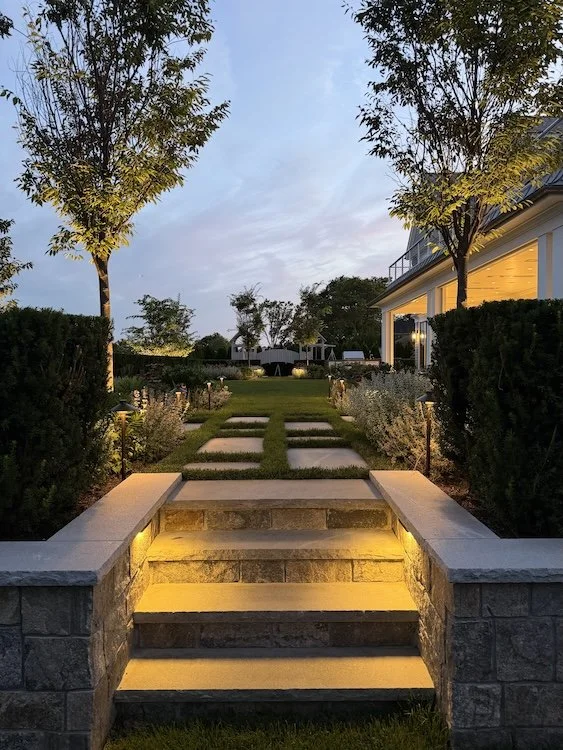
In Garden City, NY, a Nassau County project, hardscape lights were placed directly into the lip of the steps. The homeowners wanted better visibility at night because they were concerned about trips and falls, but the staircase also needed to retain its appearance as part of the property's hardscape.

Location: Garden City, NY.
Integrating the lights into the step created a very clean result. The illumination defines the stairs without making the fixtures the visual focus. Instead of seeing a row of lights attached to the staircase, the eye reads the staircase itself.
That distinction is particularly important when the material of the steps contributes to the character of the landscape. Lighting should reveal the architecture rather than compete with it.
Location: Hewlett, NY.
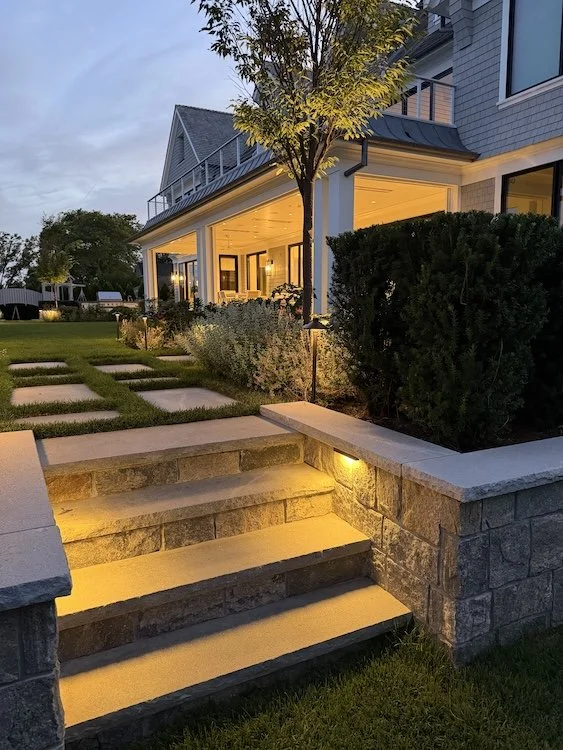
A different solution was used on a project in Hewlett, NY, also in Nassau County. There, the step lights were positioned along the sides of the staircase and directed downward.
The homeowners had a similar reason for adding the lighting: they wanted the stairs to be safer and easier to navigate at night. But the placement also created a softer visual effect. Rather than illuminating each step individually, the downward light created a continuous path through the staircase.
Neither approach is inherently better for every property. The two projects demonstrate why outdoor step lighting needs to respond to the specific staircase rather than follow a standard installation pattern.
The same principle applies to properties throughout Nassau and Suffolk County. A staircase in Garden City may present completely different design opportunities from one in Huntington, Southampton, Sag Harbor, or another Long Island community. The architecture and landscape should determine the lighting approach.
How to highlight steps without overlighting your Long Island home
One of the easiest ways for outdoor stair lighting to look wrong is for the fixtures to become more noticeable than the stairs themselves.
That can happen when fixtures are too bright, poorly positioned, or installed in locations where people naturally see the light source. It can also happen when the lighting is inconsistent with the rest of the landscape.
The purpose of a step light is to control where light falls, not simply to make the fixture visible. This becomes particularly important with natural materials. Stone steps, for example, have texture and variations in color that can disappear under flat or excessive illumination. Carefully directed light can instead bring out the edges, texture, and depth of the stone.
The same principle applies to brick, concrete, wood, and other outdoor materials. The material itself should remain part of the design.
In this sense, good step lighting is less about making the stairs bright and more about making their structure easy to read.
How step lighting fits into a Long Island landscape lighting plan
A staircase rarely exists on its own.
It might connect a terrace to a lower garden, lead from a pool area to an outdoor lounge, or sit between a retaining wall and a planting bed. The way it is lit affects how all of those spaces relate to one another at night.
This is where consistency with the rest of the landscape lighting becomes especially important.
Imagine walking from the house onto a patio, following a pathway toward the garden, and then reaching a staircase. If the pathway lighting has one visual character and the step lighting suddenly looks completely different, the transition can feel disconnected.
When the lighting is designed as one system, the staircase becomes part of the same visual story.
The pathway leads toward the stairs. The stairs lead toward another outdoor space. Trees, planting, architectural elements, and hardscape continue to provide depth around the path.
The lighting does not need to be identical throughout the property. It simply needs to feel intentional and compatible.
That is what gives a landscape a finished appearance after dark.
Why fixture quality and hidden wiring matter for outdoor step lighting
The visual result is also influenced by details that may not be obvious once the project is complete.
Fixture quality matters because outdoor lights are exposed to the elements, but it also matters because the fixture is part of the physical design of the staircase. A poorly chosen fixture can look out of place even when it provides adequate illumination.
The same is true of installation.
Wiring should be carefully managed and concealed wherever possible. Fixtures should be integrated into the hardscape or landscape in a way that does not leave the installation looking unfinished.
These details are easy to overlook when looking at an outdoor lighting project only from a technical perspective. From the homeowner's perspective, however, they are part of the final result.
The goal is for the staircase to look like it belongs there.
That matters whether the project is a smaller residential property in Nassau County or a larger estate in Suffolk County. The scale may change, but the principle remains the same: the lighting should look intentional from every angle.
What makes outdoor step lighting look natural?
There are several elements that come together to create that result, but they all lead back to the same principle: the lighting should work with the property rather than compete with it.
The staircase needs enough illumination for safe movement. The fixtures need to be positioned according to the structure and surroundings. The light should be controlled to avoid unnecessary glare. Wiring and hardware should be discreet. And the step lighting should relate visually to the rest of the landscape lighting.
Most importantly, the lighting should respect what is already interesting about the staircase.
If the steps are made from beautiful stone, the lighting should reveal the stone. If the staircase has a strong architectural shape, the lighting should reinforce that shape. If the stairs connect two important outdoor spaces, the lighting should make that transition feel natural.
The result should be a staircase that feels warmer and more inviting at night without losing the character it has during the day.
Outdoor step lighting for homes in Nassau and Suffolk County
For homeowners considering step lighting on Long Island, safety is a natural place to start. But the most successful designs go beyond simply making stairs visible.
Outdoor step lighting can create a warm path through the property, highlight the character of the hardscape, and connect different outdoor spaces into one cohesive nighttime environment. The right solution depends on the staircase, the architecture, the surrounding landscape, and the way the property is experienced after sunset.
Whether a home is in Nassau County or Suffolk County, the same design principle applies: step lighting should feel like part of the property rather than a separate lighting project. The staircase should be safer to navigate, but it should also contribute to the way the home looks and feels at night.
If you have any questions or need assistance with landscape lighting services for your property, we're here to help. We offer professional design and installation services on Long Island, NY (Nassau County and Suffolk County), and the surrounding areas. Contact us today and we’ll connect you with one of our expert lighting designers to discuss your needs and provide a custom design proposal for your home.