
How landscape lighting can enhance your outdoor living space

Location: Lake Success, NY.
There is a moment every evening on Long Island when beautifully designed homes slowly fade into darkness. The architecture is still there, the landscaping is still carefully maintained, the patio furniture still perfectly placed, but the entire scene flattens once the sun disappears. What was once a layered, intentional outdoor environment becomes something unseen until morning.
For many homeowners across Nassau County and Suffolk County, that shift feels like a missed opportunity.
Outdoor spaces today are no longer treated as simple backyards. They are extensions of the home, places built for entertaining, relaxing, cooking, and spending time with family. Yet without the right outdoor lighting, even the most thoughtfully designed outdoor living space loses its presence at night.
This is where landscape lighting quietly changes everything. Not by making the yard brighter, but by revealing it in a completely different way.
When done correctly, outdoor lighting does not feel added on. It feels like the home was always meant to look that way.
Outdoor living spaces on Long Island, NY are meant to be experienced after sunset
Across Nassau County and Suffolk County, outdoor living has become a central part of residential design. Custom patios, outdoor kitchens, fire pits, stone walkways, pergolas, pools, and garden seating areas are no longer luxury add-ons – they are expected features in many homes.
But there is a disconnect that often goes unnoticed.
A significant portion of daily life happens after sunset, especially in spring, summer, and early fall. Without landscape lighting, those carefully designed spaces are essentially shut down for half the day.
Professionally designed outdoor lighting installation changes that dynamic completely.
Patios become evening gathering spaces instead of unused corners of the yard. Walkways feel intentional and welcoming instead of disappearing into darkness. Trees, which often serve as the backbone of the landscape, become sculptural focal points rather than invisible background elements.
Instead of looking at the backyard through a dark window, homeowners begin living in it.
That shift is often what surprises people the most – not the brightness, but the feeling that the home suddenly gained another usable “room” after sunset.
The most common mistakes in outdoor lighting design
Many landscape lighting issues do not come from lack of effort – they come from lack of planning.
Three mistakes appear repeatedly in residential projects across Long Island:
Too many fixtures in small areas
Over-lighting a space often destroys depth. Instead of creating atmosphere, it flattens everything into uniform brightness.Poor fixture placement
Lighting placed without intention leads to glare, awkward shadows, or visual clutter. The eye no longer flows through the space naturally.Over-reliance on solar lighting
Solar fixtures are often inconsistent in brightness and color temperature. Over time, they fade, shift, or stop performing altogether, leaving uneven patches of light.
A well-designed landscape lighting system avoids all three by focusing on restraint, placement, and purpose.
Lighting is not about filling space. It is about guiding attention.
A tree that changed an entire backyard experience in Garden City, NY
Some landscape lighting projects stand out not because of how many fixtures were installed, but because of the emotional reaction they create afterward.
One Long Island project involved a full outdoor lighting installation throughout the property, including pathways, patio areas, architectural lighting, and landscape accents. But the true highlight of the entire design became a single mature tree in the backyard.
The homeowner had always been passionate about trees, and this particular tree was the centerpiece of the property. Tall, established, and full of character, it brought structure and identity to the entire outdoor living space during the day. The goal was to make sure it carried that same presence at night.
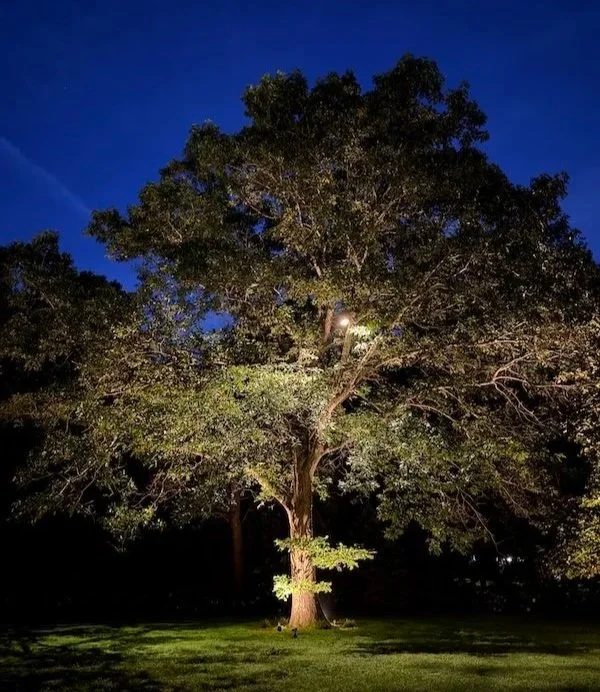
A carefully positioned spotlight was installed at the base of the tree, aimed upward with precision to carry light naturally through the trunk and into the highest branches. The effect after sunset completely transformed the space.
The bark texture suddenly became visible in a way that had never been noticed before. Branches stretched upward into layers of light and shadow, while the canopy created depth above the patio seating area. The tree no longer disappeared after dark — it became the visual anchor of the entire backyard.
What stood out most was the homeowner’s reaction.
Even though the property had received a full professional landscape lighting installation, attention kept returning to that tree. There was genuine surprise at how dramatic the result looked from such a simple lighting approach. Night after night, the homeowner found himself staring at it from the patio, amazed at how differently the tree could be experienced after sunset.
That is what thoughtful outdoor lighting design does at its best. It does not overwhelm a property with brightness or excessive fixtures. It reveals details, textures, and focal points in a way that feels natural, emotional, and timeless.
Landscape lighting as a year-round experience, not a seasonal feature
Location: Oyster Bay, NY.
A common misconception is that landscape lighting is a summer-focused upgrade. In reality, it is one of the few outdoor investments that improves with every season.
On Long Island, the landscape changes dramatically throughout the year:
Spring brings fresh growth and blooming trees
Summer delivers dense greenery and active outdoor living
Fall introduces color shifts that add warmth and contrast
Winter strips the landscape down to structure and form
Lighting interacts with all of these phases differently.
In spring, it highlights new life. In summer, it supports evening entertainment. In fall, it enhances warm tones and texture. In winter, it brings structure back into the yard when everything else feels dormant.
Unlike furniture or seasonal décor, landscape lighting does not expire with a season. It adapts.
This is why it is better understood as a capital improvement rather than a decorative upgrade – something installed once and experienced for years.
Designing outdoor lighting around how people actually live on Long Island
Every outdoor lighting design should begin with a simple question: how is the space actually used?
Some homeowners prioritize entertaining. Others focus on quiet evenings outdoors. Some want safety and visibility. Others want architectural and landscape emphasis.
There is no universal formula.

Location: Dix Hills, NY.
However, when budget allows, a balanced approach across the entire outdoor living space tends to create the most complete experience. The goal is not to eliminate darkness entirely, but to avoid dead zones where the space feels disconnected.
A strong lighting design typically considers:
Seating and conversation areas
Pathways and transitions
Outdoor kitchens and dining spaces
Trees and focal landscaping
Steps and elevation changes
Architectural features of the home
But the real priority is not the list, it is hierarchy. Some areas deserve emphasis, while others require subtle support lighting.
Good design understands the difference.
The view from inside the home matters just as much
One of the most overlooked aspects of landscape lighting design is perspective.
Many lighting plans are created as if the only viewing angle is from the yard itself. In reality, homeowners spend a significant amount of time looking at their outdoor space from inside the home – through kitchen windows, living rooms, and bedrooms.
This changes everything.
A backyard that looks balanced outdoors can feel completely different from inside if lighting is not considered carefully.
When designed properly, windows begin to function like framed scenes. Trees become silhouettes. Pathways create soft direction lines. Architectural lighting adds depth without overpowering the view.
Instead of looking out into darkness, the home looks out into a layered, living composition.
This is one of the details that separates standard installations from more intentional, design-driven landscape lighting work.
Outdoor lighting improves more than appearance
While aesthetics are usually the first reason homeowners consider outdoor lighting, the long-term impact is often behavioral.
Once a property is properly illuminated, usage patterns change:
Outdoor spaces are used more frequently after work
Entertaining becomes more comfortable and natural
Families spend more time outside instead of staying indoors
Evening relaxation shifts from interior rooms to patios and gardens
The home feels more secure and grounded at night
There is also an emotional shift that is harder to quantify.
A well-lit home feels more complete. There is a sense of calm when stepping outside at night and seeing the property softly illuminated instead of disappearing into darkness. There is pride in how the home presents itself at all hours, not just during the day.
For many homeowners, this becomes one of the most valued parts of the investment.
Safety without sacrificing atmosphere
Safety is a practical benefit of landscape lighting, but it should never come at the cost of atmosphere.
Bright floodlights may improve visibility, but they often create harsh shadows and a commercial feeling that does not belong in residential outdoor living spaces.
Low voltage landscape lighting solves this by introducing controlled illumination where it is needed most:
Steps become visible without glare
Walkways are gently guided rather than overexposed
Entry points are lit without feeling harsh
Transitions between spaces become intuitive
The result is safety that feels natural, not intrusive.
Why low voltage landscape lighting is the standard for Long Island homes
Across Nassau County and Suffolk County, low voltage systems remain the preferred choice for residential outdoor lighting.
The reasons are practical and long-term:
Greater control over brightness and beam angles
Better fixture quality and durability
Safer installation around landscaping and hardscapes
More refined color temperature options
Easier long-term maintenance and upgrades
Long Island weather also plays a role. From coastal air to seasonal temperature shifts, outdoor systems need to withstand constant environmental change. Professional-grade fixtures are built for that reality in a way most DIY or solar products are not.
The home that continues after dark
The most successful landscape lighting projects are not noticed because of the fixtures themselves. They are noticed because of how the home feels once the sun goes down.
Outdoor living spaces become usable again at night. Trees become focal points instead of background elements. Architecture gains depth and presence. And the entire property begins to feel like a continuous experience rather than a daytime-only setting.
On Long Island, where homes are often significant personal investments, landscape lighting ensures that investment does not disappear after sunset.
Instead, it continues – quietly, beautifully, and intentionally – every night of the year.
If you have any questions or need assistance with landscape lighting services for your property, we're here to help. We offer professional design and installation services on Long Island, NY (Nassau County and Suffolk County), and the surrounding areas. Contact us today and we’ll connect you with one of our expert lighting designers to discuss your needs and provide a custom design proposal for your home.